Vol. 4 No. 22 (2019): The State that protects us: Communities, Natural Resources and Nature Rights

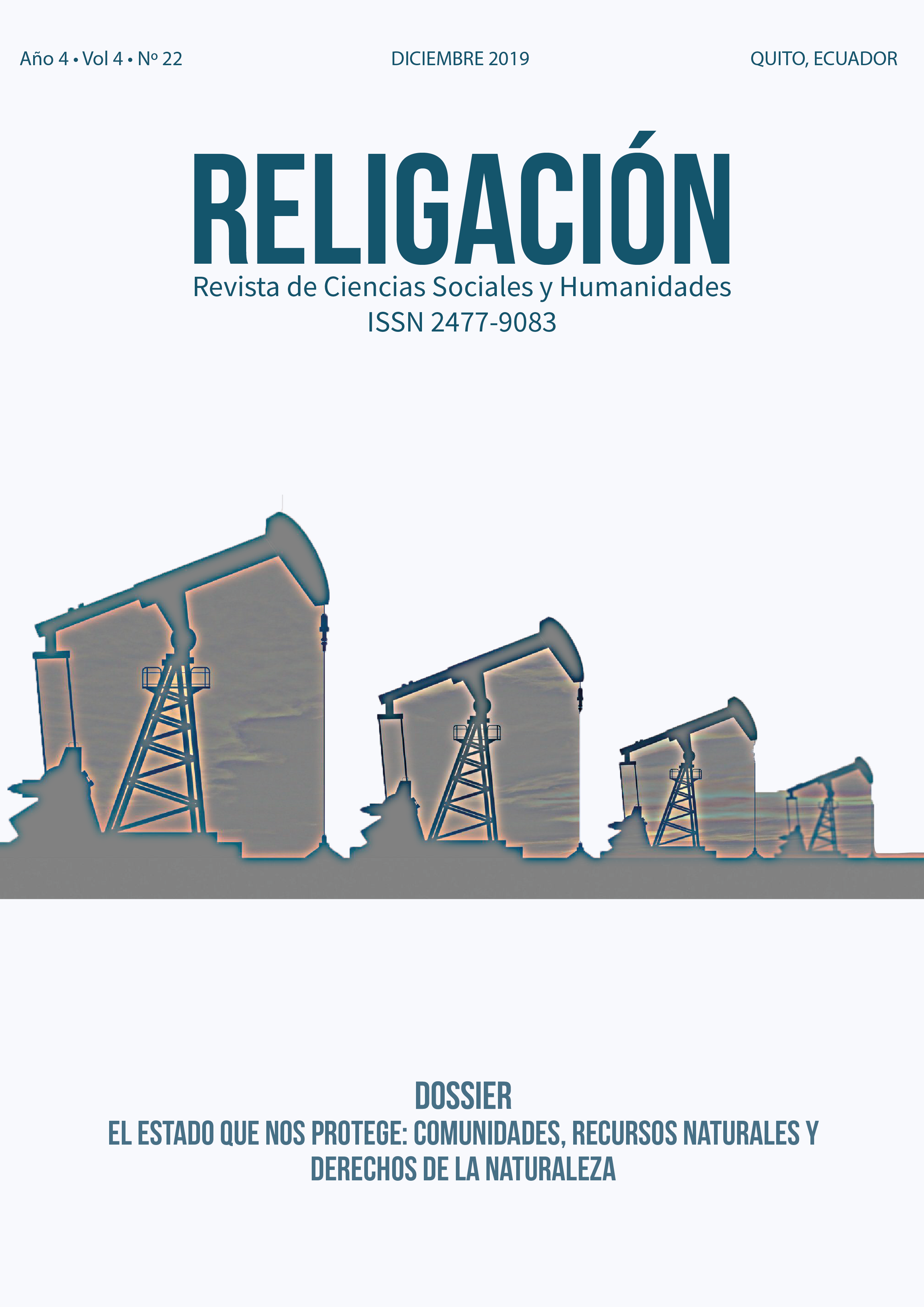
The State that protects us: Communities, Natural Resources and Nature Rights

Extractivism has become the concept that best defines the public policy of modern national states in Latin America, towards Natural Resources. This concept arises and is positioned from: a political position that questions, the Development and the subordination of the State to Multinational interests to which conservation and life matter little, and an option with the search for alternatives to the environmental crisis, alternatives that They find it necessary and inevitable to overcome capitalism as the system that governs life on the planet.

Eloy Alfaro. Faculty of Sociology, University of Cuenca - Ecuador zancudo.irreverente@gmail.com

* Anthropologist, Master in Anthropology from FLACSO Ecuador, as a Social Researcher has published academic articles, on topics of history, culture, philosophy and politics. As a writer he has published several poetry books, he is currently an academic at the University of Cuenca, a consultant and social activist.
General Section

Kamariah Abu Bakar, Aidah Abdul Karim, Nur Aidah Rashid
43-49
Young Children’s Use of Manipulatives to Represent Addition Concept
PDF
Noorul Hidayah Azman, Suziyani Mohamed, Maslawati Mohamad
50-56
Validity and reliability of questionnaire on preschool Teachers’ self-efficacy in the teaching of English as a second language
PDF
Razieh Alizad Arablouye Bishe, Mehrdad Moharramzadeh, Sirous Ahmadi
57-62
The Impact of On-The-Job Pilates Exercise on Job Satisfaction among the Female Employees of Urmia Electricity Distribution Company
PDF
Zainab Zomorodin, Ali Rasouli, Habibollah Saeedi Nia, Mohammad Mansouri Moghaddam
63-70
Social Mobility of Farsi Women Based on Economic Components in the Period of 1921 to 1953
PDF
Nalezhda Grinchinko, Irina Ignatovskaya, Konstantin Cheprasov, Vera Zubkova
71-78
Inter-budget relations as a form of federalism
PDF
Nik Narimah Nik Abdullah, Nurfaradilla Mohd Nasri, Muhammad Helmi Norman, Juritah Misman
79-85
Curriculum development model for Cross-Cultural Corporate Identity course in Graphic Design Programme
PDF
Hamidreza Kazemi, Naser Hamidi, Babak Hajikarimi, Kamyar Kavosh
86-94
A Universal Banking Model Based on Empowerment and Skills Development
PDF
Tatyana Volkogon, Alexander Molotov
95-103
Declaring on income, expenses and property by public officials: Russian practice and foreign experience
PDF
Harun Baharudin, Rahil Mohd Ghazali, Nordin Halias
104-109
YouTube application in supporting students’ Arabic listening skills
PDF
Anton Shirayev
110-114
Cybercrime as a global security threat
Igor Vasev, Konstantin Sinkin, Oksana Avilova, Yuriy Zelenin
115-120
Code in the system of alternative regulatory legal acts: priority issues
PDF
Mohd Hanafi Mohd Yasin, Rabaishah Azirun, Rozita Zaratang
121-126
School administrators’ willingness to receive inclusive education
PDF
Yulia Mihailenko, Inna Prasolova
127-133
Economic and legal subordination in modern trends of labor law development
PDF
Abd Aziz Abd Samad, Nor Aishah Buang, Asmar Yulasri , F. Ernawati
134-139
The Influence of Formal Authority and Delegator Teaching Style on Students’ Enjoyment In The Business Studies Subject
PDF
Mina Torabi, Mohammad Javad Jafari, Masood Ghasemi
140-148
Challenges of criminalization protest and corruption by looking at international documents
PDF
Anton Vasiliev, Victoria Mukhopad
149-156
The ruling layer in the teachings of G. Mosca, V. Pareto and classics of Eurasianism: comparative legal analysis
PDF

South-South

Mahsa Molavi
169-177
Third Party Funding in International Arbitration in Iran
PDF
Evgeniy Petuchov, Mariya Neymark, Nina Dudko
178-185
Favorable legal environment as a condition for the realization of criminal procedural rights and the proper performance of criminal procedural duties
PDF
Azlina Abdul Aziz, Nurul Shahira Mohd Raffi
186-195
Developing board games to teach literary elements in ‘To Kill a Mockingbird’
PDF
Samaneh Rahnama
196-205
Manifestation of Translation Strategies via Think-aloud Protocol
PDF
Lyudmila Konovalova
208-221
Parliamentarianism: concept, signs, and problems of development in Russia
PDF
Mitra Dahesh
222-225
The Role of painting in prevention of crime
PDF
Mohd Jasmy Abd Rahman, Low Weng Sheng, Nur Kamariah Ensimau
226-233
The relationship between efficiency and level of satisfaction on Continuing Professional Development among teachers
PDF
Dmitry Pyatkov, Margarita Pyatkova, Ulvi Amilogly Aliyev, Polina Savitskaya
234-249
Noisy behavior of residents of an apartment building as a matter of neighborly law (the case of relationship between dog owners and neighbors)
PDF
Aderlin Chung Kim Yuk, Melor Md Yunus, Ashairi Suliman
250-258
Using social media in writing among Primary School pupils
PDF
Hussein Aftabi, Arash Moshfegi
259-267
Discourse Theory: Language, Politics, and Society
PDF
Irina Akimova, Shapiev Siyabshakh , Olga Blinova, Vera Mankovskaya, Olga Kitnovskaia
268-273
Electronic voting in modern Russia: discussions, technologies, am experiments
PDF
Nurjailam Hamzah, Siti Mistima Maat, Zanaton H. Iksan
274-278
The effect of fun and interactive games as a strategy in teaching coordinates to enhance students’ performance in Mathematics
PDF
Irina Kiryushina, Andrey Serebryakov
279-285
Legal protection of cross-border use of intellectual property
PDF
Anastasia Y. Pleshakova
286-291
Vocational Education Systems in Germany and Turkey: Comparative Analysis
PDF
Mohd Effendi Ewan Mohd Matore, Tengku Elmi Azlina Tengku Muda
292-298
The Diversity of Adversities with Psychometric Properties Assessment across Youth Categories through Rasch Model
PDF